Start Your Approval Process
Planning interior decoration works in Dubai may look simple, but even small fitout changes can require proper authority coordination. For many shops, offices, retail units, restaurants, clinics, warehouses, and commercial spaces, the Dubai Municipality self-decor permit is an important approval route for carrying out eligible interior decoration works without going through a full building modification permit.
This guide explains the Dubai Municipality Approvals process for self-decor works, required documents, BPS Dubai submission steps, consultant and contractor coordination, common delays, and when other NOC approvals in Dubai may also be required.
The exact requirement depends on the project location, unit size, activity, fitout scope, building management rules, developer requirements, and whether the works affect fire safety, structure, MEP services, or approved building layouts.
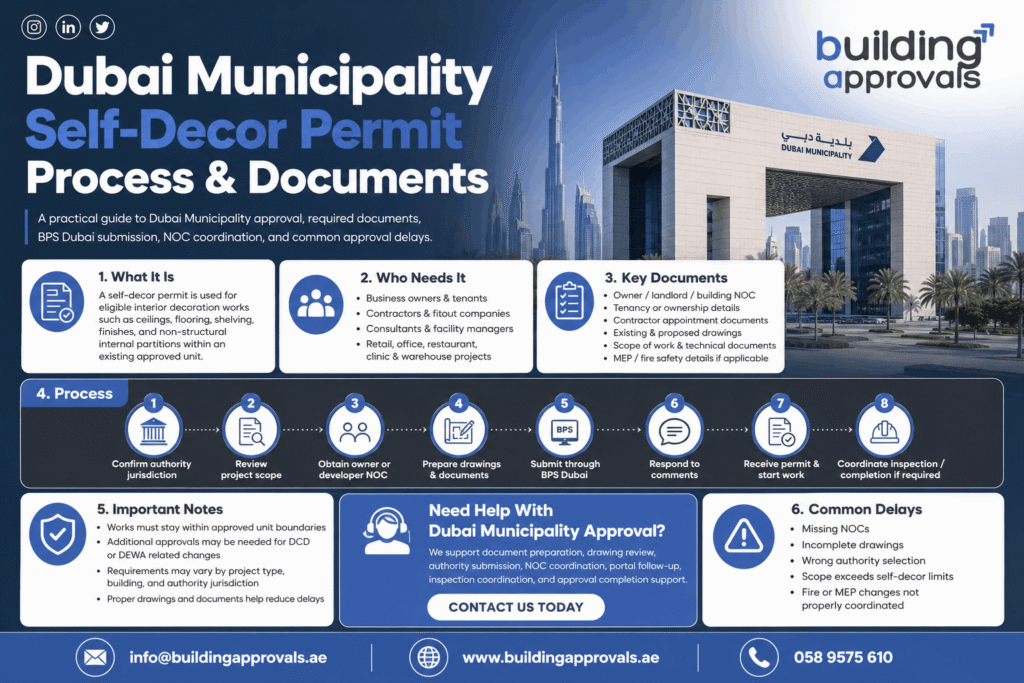
What Is a Dubai Municipality Self-Decor Permit?
A Dubai Municipality self-decor permit is a simplified permit route for eligible internal decorative works within an existing building unit. It is mainly used for decoration and fitout items that do not change the approved built-up area, structural system, main building use, or approved unit boundaries.
In practical terms, it may cover works such as:
- Suspended ceiling works
- Flooring replacement or installation
- Shelving and fixed display elements
- Light internal partitions, where non-structural
- Decorative finishes
- Minor interior layout works within the approved unit boundary
It is different from a full building modification permit. If the project includes structural changes, slab cutting, mezzanine works, change of use, additional built-up area, wet area relocation, major MEP changes, or fire and life safety redesign, the project may require a separate Dubai Municipality approval, Dubai Civil Defence approval, DEWA approval Dubai, or other authority permits.
Who Needs This Approval?
A self-decor permit may be required by businesses and project teams planning eligible decorative or fitout works in the Dubai Municipality jurisdiction.
It is commonly relevant for:
- Business owners opening a new shop, office, restaurant, clinic, or showroom
- Tenants carrying out commercial fitout works
- Fitout contractors handling decoration works
- Interior design and engineering consultants
- Real estate owners leasing commercial units
- Facility managers managing tenant modifications
- Developers and building management teams reviewing tenant works
- Warehouses, retail outlets, and service businesses are making internal improvements
For properties located in free zones or developer-controlled communities, the process may not be under the Dubai Municipality only. Areas under DDA approval, Trakhees approval, JAFZA NOC, TECOM NOC, Nakheel NOC, Concordia approval, or other master developer systems may follow a different fitout approval process.
When Is the Self-Decor Permit Required?
The Dubai Municipality self-decor permit is usually considered when the decoration works fall within the approved building unit and do not involve major structural or planning changes.
As a practical guide:
- Units exceeding 100 square metres may need a self-decor permit submission through BPS Dubai for eligible decorative works.
- Smaller units or units in certain commercial centre scenarios may have simplified requirements, subject to Dubai Municipality conditions.
- Work must generally remain within the approved unit boundaries.
- The works must not add, remove, merge, divide, or modify approved built-up areas.
- The tenant should obtain approval from the owner, landlord, mall management, or building management.
- The contractor must be properly approved or registered where required.
- Fire and life safety requirements must still be respected.
Do not assume that “minor decoration” means “no approval.” A ceiling change, partition layout, restaurant fitout, kitchen modification, clinic layout, warehouse racking layout, or electrical load change can trigger additional authority review.
Why Is This Approval Important?
Dubai authority approvals are not only paperwork. They protect the property, occupants, neighbouring tenants, and business operations.
A proper Dubai Municipality Approval helps to:
- Confirm that the proposed decoration works are within the approved unit
- Avoid illegal construction or unapproved fitout activity
- Reduce the risk of stop-work notices
- Support building management approval
- Maintain fire and life safety compliance
- Avoid issues during inspection or handover
- Support final approval or completion certificate requirements
- Keep the tenant’s commercial operation compliant
For commercial fitout projects, a missing DM approval, DM Permit, or developer NOC can delay handover, trade licence activity approval, utility connection, Civil Defence inspection, or final occupancy clearance.
Authorities Involved in Self-Decor and Fitout Approvals Dubai
The main authority for a Dubai Municipality self-decor permit is Dubai Municipality through the Building Permit System, commonly known as BPS Dubai.
Depending on the project, other parties may also be involved.
Dubai Municipality
Dubai Municipality reviews building and decoration works in mainland Dubai areas under its jurisdiction. For eligible self-decor works, submission may be made through BPS Dubai by the approved contractor.
Dubai Civil Defence
Dubai Civil Defence approval may be required if the fitout affects fire alarm, firefighting, emergency lighting, exit routes, occupancy load, fire-rated partitions, kitchen fire suppression, LPG systems, or any fire and life safety element. Even where a separate DCD approval is not required, the works must still comply with applicable Civil Defence requirements.
DEWA
DEWA approval Dubai may be required if the project involves new electrical load, meter changes, additional power requirements, water connection changes, or related MEP modifications.
Building Owner, Landlord, or Developer
A building management or developer NOC is usually required before submission or site work. This is often one of the first documents requested for fitout approvals Dubai.
Other Jurisdictions
If the unit is not under Dubai Municipality jurisdiction, approvals may fall under another authority or developer system, such as:
- DDA approval for Dubai Development Authority areas
- Trakhees approval for certain ports, free zone, and special development areas
- JAFZA NOC for Jebel Ali Free Zone projects
- TECOM NOC for TECOM-regulated communities
- Nakheel NOC for Nakheel communities
- Concordia approval for DMCC/JLT-related fitout works
- RTA NOC Dubai, usually only where road access, right-of-way, external works, parking, signage, outdoor seating, or traffic-related impacts are involved
Required Documents for Dubai Municipality Self-Decor Permit
Document requirements may vary depending on the unit type, project scope, building management requirements, and authority comments. However, a typical document set may include:
Basic Property and Tenant Documents
- Ejari or tenancy contract, where applicable
- Trade licence or initial business licence details
- Title deed or ownership documents, where relevant
- Unit number, plot number, Makani number, and building details
- Tenant or owner Emirates ID and contact details, where requested
NOC and Appointment Documents
- Landlord or property owner NOC
- Building management or mall management approval
- Developer NOC, if the property is in a developer-controlled community
- Contractor appointment letter from the tenant or owner
- Consultant appointment letter, if a consultant is involved
Contractor and Consultant Documents
- Contractor trade licence
- Dubai Municipality contractor registration or approval details, where applicable
- Consultant registration details, if drawings require consultant certification
- Company stamp and authorised signatory details
Drawing Submission Requirements
The authority may request clear and coordinated drawings, such as:
- Existing layout drawing
- Proposed layout drawing
- Reflected ceiling plan
- Flooring layout
- Internal partition layout
- Door and access layout
- Furniture or shelving layout, where relevant
- Electrical layout, if electrical works are included
- HVAC layout, if air-conditioning changes are included
- Plumbing and drainage layout, if wet services are affected
- Fire and life safety layout, if required
- Section details and material specifications, where applicable
Technical Documentation
Depending on project scope, additional technical documents may include:
- Scope of work description
- Method statement
- Material specifications
- Load schedule for electrical works
- Fire-rated material certificates, where applicable
- DCD-related documents, if fire safety works are involved
- DEWA documents, if utility load or service changes are involved
- Photos of existing site condition
- Approved base building drawings, if requested
Incomplete or mismatched drawings are one of the most common reasons for DM approval delays.
Step-by-Step Dubai Municipality Self-Decor Permit Process
Step 1: Confirm the Property Jurisdiction
Before preparing drawings, confirm whether the unit falls under Dubai Municipality, DDA, Trakhees, JAFZA, TECOM, Nakheel, Concordia, or another authority. Many delays happen because the project is submitted to the wrong authority or the developer NOC is missing.
Step 2: Review the Fitout Scope
Check whether the work is purely decorative or whether it includes structural, MEP, fire safety, wet area, kitchen, clinic, industrial, or warehouse-related modifications.
If the work goes beyond the self-decor scope, a full fitout approval or building modification approval may be required.
Step 3: Obtain Building Owner or Developer NOC
Before authority portal submission, obtain approval from the landlord, building management, mall operator, or master developer. This NOC confirms that the owner has no objection to the proposed works.
Step 4: Appoint an Approved Contractor or Consultant
For self-decor permit submission, coordination with a properly approved contractor is important. Some projects may also require consultant involvement, especially where drawings need technical review or authority coordination.
Step 5: Prepare Drawings and Technical Documents
The contractor or consultant prepares the required drawings based on the actual site and proposed fitout scope. Drawings should match the tenancy details, unit area, approved building layout, and NOC scope.
The submission should clearly show that works remain within the approved unit boundaries and do not create an unauthorised built-up area.
Step 6: Submit Through BPS Dubai
The application is submitted through the Dubai Building Permit System. The relevant service is selected, documents and drawings are uploaded, and the application is submitted for permit issuance or system processing.
Step 7: Respond to Comments, If Any
Although self-permit services may be designed for faster processing, comments or clarifications may still arise if the submission is incomplete, the scope is unclear, or another authority approval is required.
Typical comments may relate to:
- Missing owner NOC
- Unclear proposed layout
- Contractor details not matching
- Fire safety impacts
- MEP changes not supported by drawings
- Unit area or boundary mismatch
- Wrong service category selection
Step 8: Receive Permit and Start Work
Work should start only after the required permit, NOC, or authority clearance is issued. The contractor should keep approved documents available at site.
Step 9: Coordinate Inspection or Completion, If Required
For some self-decor works, completion procedures may be required through BPS Dubai. For projects involving DCD, DEWA, or other authorities, inspection coordination may also be required before final approval or completion certificate.
Estimated Timeline
The timeline depends on scope, documentation quality, NOC readiness, and whether other authorities are involved.
For a straight forward, eligible self-decor submission, the permit may be processed quickly through the relevant platform when all requirements are correct. However, practical project timelines usually include time for:
- Site survey
- Drawing preparation
- Landlord or developer NOC
- Contractor appointment
- BPS Dubai submission
- Comment resolution, if any
- Inspection or completion coordination, if required
If the project requires Dubai Civil Defence approval, DEWA approval Dubai, developer NOC, or additional fitout approvals Dubai, the timeline can extend depending on each authority’s review process and project complexity.
Approval timelines should not be treated as guaranteed. They remain subject to authority review, system requirements, document accuracy, and the project’s technical scope.
Common Reasons for Rejection or Delay
Dubai Municipality Approval delays usually happen for practical reasons that can be avoided with proper preparation.
Common issues include:
- Wrong authority jurisdiction selected
- Missing landlord or building management NOC
- Unit area not matching the submitted documents
- Contractor not approved or not correctly appointed
- Drawings not matching the actual site condition
- Proposed works exceeding self-decor scope
- Internal partitions affecting exits or fire safety routes
- Ceiling works affecting sprinklers, detectors, or emergency lights
- Electrical changes submitted without load details
- DEWA approval not considered for additional load
- DCD approval not considered for fire and life safety changes
- Wet services changed without plumbing or drainage drawings
- Unclear scope of work
- Work started before permit issuance
- Missing completion or inspection coordination
A strong document set at the beginning can reduce resubmissions and avoid unnecessary site delays.
Important Compliance Points
Before applying for a Dubai Municipality self-decor permit, keep these compliance points in mind:
- Works must remain within the approved unit boundaries.
- Do not add, remove, merge, or divide built-up areas without proper approval.
- Do not touch structural elements unless a specific structural approval is obtained.
- Do not relocate fire safety systems without proper DCD coordination.
- Do not increase electrical load without checking DEWA requirements.
- Do not start site work based only on verbal landlord approval.
- Keep approved drawings and permits available at site.
- Use approved contractors and qualified technical teams.
- Confirm whether a completion certificate or final inspection is required.
- Verify developer rules before submission, especially in malls, free zones, and master communities.
For restaurants, clinics, warehouses, industrial units, beauty salons, gyms, and food-related businesses, additional approvals may be required because the activity itself can trigger health, safety, fire, ventilation, drainage, or utility requirements.
Benefits of Hiring a Dubai Authority Approval Consultant
A Dubai fitout approval consultant can save time by checking the project before submission and identifying missing approvals early.
A professional authority approval consultant in Dubai can support with:
- Scope review and authority route confirmation
- Dubai Municipality approval strategy
- Drawing review and compliance checking
- Technical documentation preparation
- Landlord, developer, and building management NOC coordination
- BPS Dubai portal submission
- Contractor and consultant coordination
- Dubai Civil Defence approval coordination, where required
- DEWA approval coordination, where required
- Comment response and resubmission
- Inspection coordination
- Final approval or completion certificate support
This does not guarantee approval, but it can improve submission readiness, reduce avoidable errors, and help the project move through the correct approval route.
FAQs for Dubai Municipality Self-Decor Approval
1. Is Dubai Municipality Approval required for my self-decor fitout project?
It depends on the unit size, location, activity, and scope of work. Eligible decorative works may follow the self-decor route, while structural, MEP, fire safety, or layout changes may require additional approvals.
2. Can work start before getting the self-decor permit?
No. Site work should not start before the required permit, landlord NOC, developer NOC, or authority approval is issued. Starting early can lead to stop-work notices, fines, or handover delays.
3. What documents are required for a Dubai Municipality self-decor permit?
Common documents include landlord NOC, tenancy or ownership details, contractor appointment letter, contractor licence, existing and proposed drawings, scope of work, and supporting technical documents. Extra documents may be required depending on the project.
4. Do I need Dubai Civil Defence approval for self-decor works?
Not always. However, if the works affect sprinklers, fire alarm devices, emergency lighting, exit routes, fire-rated walls, kitchen systems, or occupancy safety, Dubai Civil Defence approval or inspection may be required.
5. Is DEWA approval required for decoration works?
DEWA approval is usually relevant when there is additional electrical load, meter modification, water connection change, or MEP service alteration. Simple decorative finishes may not require DEWA approval, but this should be checked before submission.
6. How long does the Dubai Municipality self-decor permit take?
The authority service may be quick for eligible and complete submissions, but the practical timeline depends on document readiness, NOC availability, portal submission accuracy, and whether DCD, DEWA, or developer approvals are also required.
7. Why do self-decor permits get delayed?
Delays usually happen due to missing NOCs, unclear drawings, wrong authority selection, contractor registration issues, mismatched unit areas, or works that exceed the self-decor scope.
8. Do I need a consultant for submission?
A consultant is not always required for every simple decoration scope, but hiring an experienced Dubai authority approval consultant is recommended when the project involves commercial fitout, multiple NOCs, technical drawings, DCD/DEWA coordination, or tight handover deadlines.
Conclusion
- The Dubai Municipality self-decor permit is a useful approval route for eligible internal decoration works in Dubai. It helps businesses carry out fitout improvements while staying aligned with Dubai Municipality, Civil Defence, building management, and utility requirements.
- However, the self-decor route is not suitable for every project. If the works affect structure, approved unit boundaries, MEP services, fire safety, use classification, or developer rules, additional Dubai authority approvals may be required.
- Before starting any commercial fitout, retail fitout, office renovation, warehouse modification, restaurant fitout, or clinic setup, review the scope carefully and prepare compliant drawings and documents.
- Approval requirements may change from time to time and may vary by authority jurisdiction, building owner, developer, activity, and project scope. Always verify the latest requirements with the relevant authority or an experienced approvals consultant before submission.
Need help with Dubai Municipality Approval for your self-decor or fitout project?
Our Dubai authority approval consultants can assist with document preparation, drawing review, landlord and developer NOC coordination, BPS Dubai portal submission, DM approval follow-up, Dubai Civil Defence approval coordination, DEWA approval support, inspection coordination, and final approval completion.
Contact our team today to review your project scope and prepare a compliant submission for your fitout works in Dubai.