Civil defence approval is one of the most important requirements for commercial, retail, office, warehouse, restaurant, clinic, industrial and fitout projects in Dubai. Whether you are opening a new business, modifying an existing unit, changing the layout, adding partitions, upgrading MEP services, or installing a kitchen exhaust system, Dubai Civil Defence approval may be required to confirm that the premises meet fire and life safety standards.
For many tenants and contractors, the challenge is not only preparing drawings. The real challenge is coordinating the correct NOCs, submitting compliant fire alarm and fire fighting drawings, responding to authority comments, arranging inspections, and obtaining final clearance before operation. This guide explains the key fire fighting requirements, approval process, common delays, and how an authority approval consultant in Dubai can support the submission.
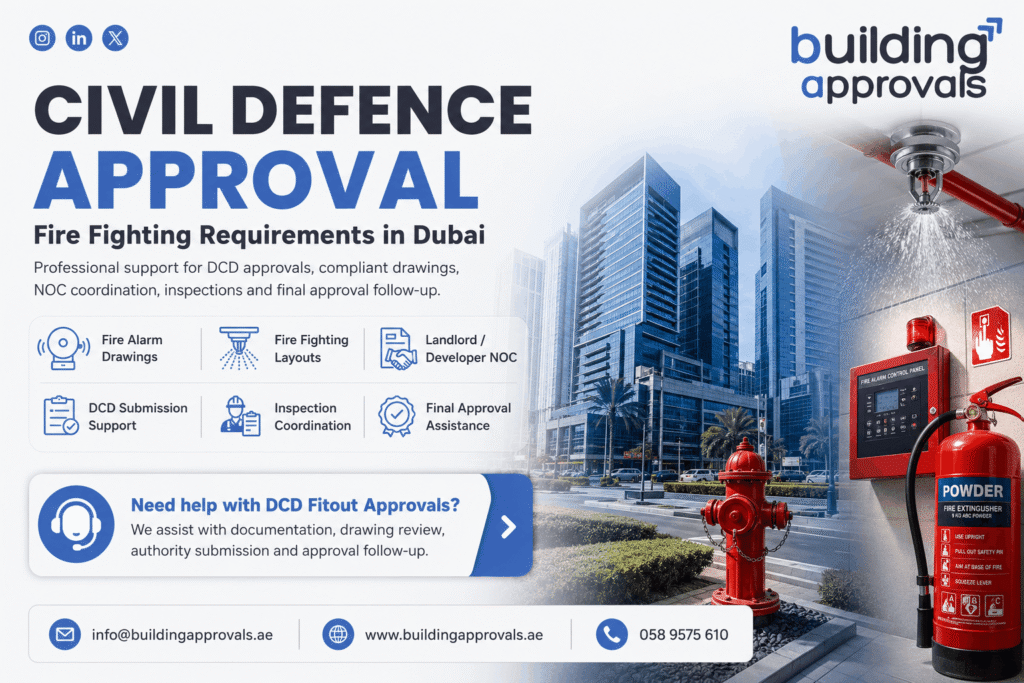
What Is Civil Defence Approval?
Civil defence approval is the official fire and life safety clearance issued through Dubai Civil Defence for projects that require review of fire protection, fire alarm, emergency systems, evacuation routes, fire-rated elements, and related safety requirements.
For fitout approvals in Dubai, DCD approvals Dubai usually focus on whether the proposed layout and MEP works affect fire safety. This can include sprinkler relocation, fire alarm detector layout, emergency lighting, exit signage, hose reel access, fire extinguisher placement, kitchen suppression systems, smoke control, fire-rated doors, and safe escape routes.
In simple terms, Civil Defence approval confirms that the proposed design and completed works are acceptable from a fire safety point of view, subject to authority review and inspection.
Who Needs Civil Defence Approval in Dubai?
Civil defence approval may be required by:
- Business owners opening a new commercial unit
- Tenants carrying out office, retail, restaurant, clinic, warehouse, or showroom fitout
- Fitout contractors modifying partitions, ceilings, MEP services, or fire systems
- Property owners changing building use or internal layouts
- Facility managers upgrading fire alarm or fire fighting systems
- Developers and consultants submitting new construction or modification projects
- Restaurants and cloud kitchens installing cooking equipment or exhaust systems
- Industrial and storage facilities with higher fire risk
The exact requirement depends on the location, building type, activity, fitout scope, landlord requirements, and the applicable authority jurisdiction.
When Is Civil Defence Approval Required?
Civil Defence approval is usually required before starting works that may affect fire and life safety systems. It may also be required before receiving final approval, completion certificate, trade license activation, or operational clearance.
Common situations include:
- New commercial fitout works
- Office partition and ceiling modifications
- Retail shop or showroom fitout
- Restaurant, café, cloud kitchen, or food outlet setup
- Warehouse racking, storage, or industrial activity approval
- Clinic, salon, gym, spa, or healthcare-related fitout
- Fire alarm or fire fighting system modifications
- Kitchen hood and suppression system installation
- Change of business activity or occupancy
- Building modification or extension works
Work should not begin without checking the approval requirement because unapproved changes can lead to redesign, rework, inspection failure, penalties, or delay in business opening.
Why Is Civil Defence Approval Important?
Civil defence approval protects people, property, and business continuity. It helps ensure that the space has reliable fire detection, suppression, evacuation, and emergency access provisions.
For businesses, approval is also important because it may be connected to other Dubai authority approvals such as Dubai Municipality approval, DDA approval, Trakhees approval, Concordia approval, JAFZA NOC, TECOM NOC, Nakheel NOC, DEWA approval Dubai, and building management NOC. In many projects, one authority approval cannot move forward unless the fire safety documents and NOCs are aligned.
A properly prepared DCD submission can reduce comments, avoid repeated resubmissions, and support smoother inspection coordination.
Authorities Involved in Fire Fighting and Fitout Approval
The main authority for fire safety review is Dubai Civil Defence. However, depending on the project location and scope, other authorities or stakeholders may also be involved.
Dubai Civil Defence
Dubai Civil Defence reviews fire and life safety requirements, including fire alarm, fire fighting, emergency lighting, exit routes, system installation, testing, and final inspection requirements.
Dubai Municipality
Dubai Municipality approval may be relevant for mainland building permits, building modifications, food establishments, structural changes, and construction-related approvals.
Dubai Development Authority
DDA approval applies in DDA-regulated areas. For many fitout projects, DDA requires a fitout permit and may require relevant NOCs, approved drawings, and Dubai Civil Defence completion before fitout completion.
DEWA
DEWA approval Dubai may be required for electricity load, fitout power connections, water connections, and related building NOCs depending on the project scope.
Trakhees, JAFZA, TECOM, Concordia and Developer NOCs
Projects in free zones, master communities, and developer-controlled buildings may require additional NOC approvals in Dubai. For example, Trakhees approval may apply in PCFC or certain free zone jurisdictions, JAFZA NOC may apply in Jebel Ali Free Zone, TECOM NOC may apply in selected business districts, Concordia approval may apply in JLT, and Nakheel NOC may apply in Nakheel-managed communities.
RTA NOC Dubai
RTA NOC Dubai is generally relevant when works affect roads, parking, external access, right-of-way, signage, or infrastructure outside the unit. It is not required for every internal fitout, but it should be checked for external works.
Required Documents for Civil Defence Approval
The document list may vary depending on the project type, but a typical DCD fitout approvals Dubai submission may include:
- Trade license or initial business details
- Ejari or tenancy contract
- Building owner or landlord NOC
- Developer or community NOC, if applicable
- Existing approved drawings, where available
- Proposed architectural layout
- Reflected ceiling plan
- Fire alarm layout
- Fire fighting layout
- Sprinkler layout and hydraulic details, where applicable
- Emergency lighting and exit signage layout
- Fire extinguisher and hose reel layout
- Kitchen hood and suppression details for restaurants
- Equipment schedule and technical datasheets
- Civil Defence-approved contractor details, where required
- Load schedule or MEP documents, if connected to DEWA or landlord systems
- Method statements or technical clarification, if requested
- Completion or testing certificates at final inspection stage
The most important point is coordination. Architectural, MEP, fire alarm, and fire fighting drawings must match each other. If the partition layout changes but the sprinkler and detector layout is not updated, DCD comments or site inspection failure can occur.
Step-by-Step Civil Defence Approval Process
Step 1: Review the Project Scope
Before submission, the consultant or contractor should review the business activity, building location, landlord requirements, authority jurisdiction, and fitout scope. A restaurant, warehouse, clinic, office, and retail shop will not have the same fire safety requirements.
Step 2: Collect NOCs and Base Documents
Most projects require building management or developer NOC before authority submission. In some locations, the landlord will also require drawings, method statements, contractor licenses, insurance documents, and work permits before issuing NOC.
Step 3: Prepare Fire Safety Drawings
The consultant prepares coordinated drawings showing fire alarm, fire fighting, emergency lighting, exits, signage, fire extinguishers, and other systems relevant to the project. For restaurants and industrial units, additional technical details may be required.
Step 4: Submit Through the Authority Portal
The application is submitted through the relevant authority portal or approved submission channel. Supporting documents and drawings must be uploaded in the correct format. Any mismatch, missing NOC, or unclear drawing can delay the review.
Step 5: Respond to Authority Comments
Dubai Civil Defence may issue comments if the submission needs correction. Common comments relate to detector spacing, sprinkler coverage, exit route obstruction, missing emergency lighting, incorrect system details, or lack of required supporting documents.
Step 6: Installation and Site Coordination
After drawing approval, the contractor should execute the works as per approved drawings. Site teams must avoid unauthorized changes because even small modifications can affect final approval.
Step 7: Testing, Inspection and Final Approval
Once works are completed, the fire alarm and fire fighting systems may need testing, commissioning, and inspection coordination. Final approval or completion certificate is issued only after compliance is verified, subject to the authority’s review.
Estimated Timeline for Civil Defence Approval
The timeline for Civil defence approval depends on the project scope, drawing readiness, authority comments, NOC availability, and inspection schedule.
For a simple office or retail fitout with complete documents, the initial review may be faster than complex projects. Restaurants, warehouses, industrial facilities, clinics, and projects involving major fire system changes usually require more coordination.
As a practical estimate, clients should allow time for:
- Document collection and drawing preparation
- Portal submission and authority review
- Comment response and resubmission, if required
- Site execution as per approved drawings
- Testing, inspection, and final completion support
Timelines should never be treated as guaranteed because approvals are subject to authority review, project complexity, building condition, and compliance status.
Common Reasons for Rejection or Delay
Civil Defence approval and Fire Fighting Approval can be delayed due to:
- Missing building management or developer NOC
- Uncoordinated architectural and fire safety drawings
- Incorrect fire alarm detector or sprinkler layout
- Blocked exits or insufficient escape route clarity
- Missing emergency lighting or exit signage
- Fire extinguishers not shown properly
- Restaurant kitchen suppression details not provided
- Unauthorized site changes after drawing approval
- Incomplete technical datasheets
- Submission by an unqualified or non-approved party
- Incorrect project information in the portal
- Delay in inspection booking or readiness
- Fire alarm and fire fighting systems not tested before inspection
Most delays can be reduced when drawings are reviewed properly before submission and site works follow the approved plan.
Important Fire Fighting Compliance Points
For commercial and fitout projects in Dubai, the following points should be checked early:
- Fire fighting and fire alarm systems must not be removed, blocked, or relocated without approval.
- Sprinklers and detectors should be coordinated with ceiling, partitions, lighting, and AC layout.
- Fire hose reels, extinguishers, and exits must remain accessible.
- Emergency lighting and exit signs must be visible and functional.
- Fire-rated doors, walls, shafts, and service penetrations must be protected where required.
- Restaurants and kitchens may require hood suppression, gas safety coordination, and exhaust-related compliance.
- Warehouse storage height, racking layout, commodity type, and aisle clearance may affect fire protection requirements.
- Final inspection should be arranged only after site readiness, testing, and documentation are complete.
Benefits of Hiring a Dubai Authority Approval Consultant
Hiring a Dubai fitout approval consultant can save time and reduce avoidable mistakes. An experienced approval consultant understands authority expectations, portal submission requirements, NOC coordination, and practical site issues.
A consultant can support with:
- Project scope review
- Required document checklist
- Building management and developer NOC coordination
- Drawing review and correction
- Fire alarm and fire fighting drawing coordination
- Authority portal submission
- Comment response and resubmission
- Coordination with contractors and consultants
- Inspection booking and readiness checks
- Final approval or completion certificate follow-up
For business owners, this support is especially useful when opening a restaurant, office, shop, warehouse, clinic, salon, or industrial facility where multiple approvals are required at the same time.
FAQs
1. Is Civil Defence approval required for my fitout project?
It may be required if your fitout affects fire alarm, fire fighting, ceiling, partitions, exit routes, emergency lighting, kitchen systems, storage layout, or occupancy use. The requirement depends on your project scope, location, and authority jurisdiction.
2. Which authority approval do I need for fire fighting works in Dubai?
Dubai Civil Defence is the main authority for fire safety approval. However, Dubai Municipality approval, DDA approval, Trakhees approval, JAFZA NOC, TECOM NOC, Concordia approval, Nakheel NOC, or developer NOC may also be required depending on the location.
3. How long does Civil Defence approval usually take?
The timeline depends on document readiness, project complexity, authority comments, and inspection availability. Simple projects may move faster, while restaurants, warehouses, clinics, and industrial projects usually need more technical coordination.
4. What documents are required for DCD approval Dubai?
Common documents include trade license, tenancy contract, landlord NOC, developer NOC, existing drawings, proposed layout, fire alarm drawings, fire fighting drawings, emergency lighting layout, technical datasheets, and completion/testing documents.
5. Can fitout work start before approval?
It is not recommended to start work before confirming the approval requirement. Starting without approval can lead to rework, failed inspection, authority comments, or delays in final clearance.
6. Why do Civil Defence approvals get delayed?
Delays usually happen because of missing NOCs, incorrect drawings, uncoordinated MEP layouts, incomplete fire system details, unauthorized site changes, or inspection readiness issues.
7. Do I need a consultant for Civil Defence submission?
A consultant is strongly recommended for projects involving fire alarm, fire fighting, restaurant kitchens, warehouses, clinics, or multiple authority approvals. Proper coordination improves submission quality and reduces avoidable delays.
8. Is inspection required after Civil Defence approval?
In many projects, inspection or final completion coordination is required after installation and testing. The final requirement depends on the project type, authority process, and approved scope.
Conclusion
Civil defence approval is a critical part of Dubai authority approvals for commercial, retail, office, restaurant, warehouse, clinic, industrial, and fitout projects. It ensures that the proposed and completed works meet fire and life safety requirements before the premises are occupied or operated.
The key to a smoother approval process is early planning, complete documentation, compliant drawings, proper NOC coordination, and site execution as per approved drawings. Because requirements may vary by authority jurisdiction, building management, project activity, and fitout scope, every project should be checked carefully before submission.
Disclaimer:
Approval requirements, documents, fees, procedures, and timelines may change based on Dubai Civil Defence, Dubai Municipality, DDA, Trakhees, DEWA, free zone, developer, or building management requirements.
Always verify the latest requirements with the relevant authority or an experienced authority approval consultant in Dubai before submission.
Need help with Civil defence approval, Fire Fighting Approval, DCD permits Dubai, or DCD NOC Dubai for your fitout project?
Our Dubai authority approval consultants can support you with document preparation, drawing review, authority submission, NOC coordination, portal follow-up, inspection coordination, and final approval completion support.
Contact us today to get your commercial, retail, restaurant, office, warehouse, clinic, or industrial fitout approval process started with the right documentation and compliance approach.