For any commercial, retail, office, warehouse, restaurant, clinic, industrial, or fitout project in Dubai, DEWA Approval is one of the most important utility-related approvals to plan correctly. Whether you are applying for a DEWA NOC, electricity fitout connection, water connection, additional load, or final utility activation, the submission usually depends on accurate drawings, load details, technical schedules, landlord or developer NOC, and proper authority portal submission.
DEWA’s official builder services include NOC services, electricity network services, electricity fitout connections, and water network services for contractors and consultants. For projects under the Dubai Municipality, certain DEWA building NOC applications are routed through the Dubai Building Permit System, while other authority jurisdictions may require submission through DEWA’s own digital channels.
This guide explains the documents usually required for DEWA approval in Dubai, the approval process, common reasons for delay, and why working with an experienced authority approval consultant in Dubai can help reduce submission mistakes.
What Is DEWA Approval?
DEWA Approval refers to the technical review, NOC, connection, inspection, or service clearance issued by Dubai Electricity and Water Authority for electricity and water-related requirements in Dubai projects.
Depending on the project, DEWA approval may include:
- Building NOC for electricity or water
- Electricity fitout connection approval
- Electricity connection approval for new buildings or projects
- Water connection approval
- Additional load approval
- LV inspection approval
- Meter installation and supply release coordination
- Infrastructure NOC, where relevant
For fitout projects, the most common requirement is usually Getting Electricity Fit-Out Connections, which DEWA defines as a service for enrolled contractors and consultants to obtain a power supply connection for shell-and-core or fitout installations.
Who Needs DEWA Approval in Dubai?
DEWA approval may be required by:
- Tenants taking a new commercial unit
- Business owners opening an office, shop, clinic, restaurant, cafe, salon, showroom, or warehouse
- Fitout contractors carrying out MEP works
- MEP consultants and electrical contractors
- Real estate owners modifying electrical or water load
- Developers and project owners constructing new buildings
- Facility management companies upgrading services
- Industrial or logistics businesses requiring a higher load
- Contractors applying for temporary or permanent connections
For many DEWA builder services, the official customer segment is contractors and consultants, and DEWA states that certain requests can be submitted only by enrolled consultants or contractors.
When Is DEWA Approval Required?
DEWA approval may be required before, during, or after fitout or construction works, depending on the project scope.
Common situations include:
- Starting commercial fitout works
- Applying for a building permit
- Increasing electrical load
- Installing or modifying DB, SMDB, MDB, or meter arrangements
- Connecting power to a shell-and-core unit
- Obtaining a water connection for a building, shop, warehouse, or development
- Coordinating LV inspection after electrical installation
- Releasing the meter connection and supply
- Obtaining landlord, developer, or building management NOC
- Completing authority approvals before business operation
For Dubai Municipality-licensed projects, DEWA indicates that some applications should be submitted through the Dubai Building Permit System, while other authority scenarios are handled through DEWA channels.
Why Is DEWA Approval Important?
DEWA approval is important because electricity and water connections must be safe, compliant, and technically suitable for the approved use of the premises.
A proper DEWA submission helps confirm:
- The connected load and maximum demand are correctly calculated
- The electrical layouts match DEWA standards
- Meter locations and distribution boards are properly shown
- The landlord or building owner has no objection
- The site is ready for inspection
- Required technical documents are uploaded in the correct format
- The project can proceed toward meter installation or supply release
For business owners and tenants, missing DEWA documents can delay fitout completion, final inspections, Ejari-linked activation, utility connection, and handover.
Authorities and Parties Involved in DEWA Approval
The main authority is the Dubai Electricity and Water Authority, but other parties may be involved depending on location and project type.
Commonly involved parties
- DEWA – electricity/water NOC, connection, design approval, inspection, meter, and supply release
- Dubai Municipality – building permit or fitout-related approval, where applicable
- Dubai Building Permit System / Build in Dubai – used for certain Dubai Municipality project submissions
- Building management or landlord – landlord NOC, access, load availability confirmation
- Developer or master community – NOC for communities such as free zones or developer-controlled properties
- RERA / Ejari – relevant for some fitout connection cases where DEWA receives premise and customer details after Ejari issuance
- RTA – may be involved for certain water connection-related service coordination, as listed in DEWA’s water connection service partners.
For projects in DDA, Trakhees, JAFZA, TECOM, Nakheel, Concordia, or other free zone/developer jurisdictions, the required NOC route may vary. The correct authority path should be checked before submission.
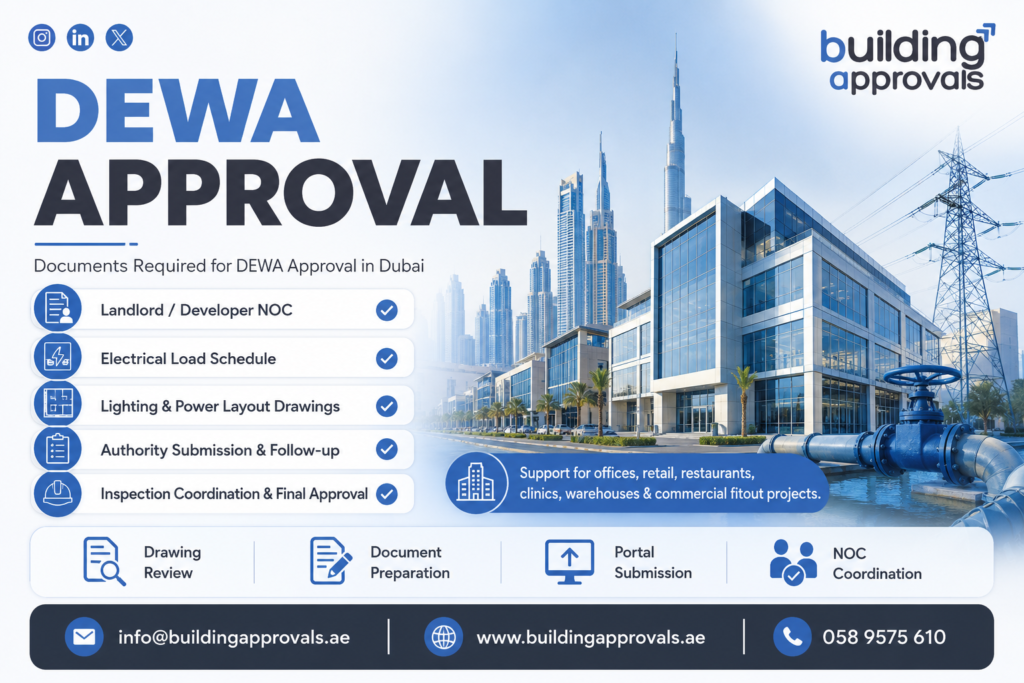
Documents Required for DEWA Approval in Dubai
The exact documents depend on whether the application is for a Building NOC, an electricity fitout connection, an electricity connection, or a water connection. Below is a practical breakdown.
1. Documents Required for DEWA Building NOC
DEWA’s Building NOC service enables enrolled contractors and consultants to obtain an electricity or water NOC for building permit purposes.
For Building NOC – Electricity
Documents may include:
- Affection plan, required if the project falls in the Dubai free zone areas
- Copy of the setting out plan
- Meter location, where applicable
- Project details information letter for the proposed load of 400 kW or above
- Contractor or consultant login and project information
- Owner or project registration details
- Supporting drawings requested through the portal
DEWA lists the affection plan for free zone areas and setting out plan requirements for Building NOC electricity, with additional project detail information for proposed loads of 400 kW or above.
For Building NOC – Water
Documents may include:
- Setting out plan showing the location of ground or underground water tank
- Project information
- Owner/contractor/consultant details
- Relevant building permit or authority reference
- Other documents requested by DEWA based on the project
DEWA specifically mentions the setting out plan showing the ground or underground water tank position for Building NOC water.
2. Documents Required for DEWA Electricity Fitout Connection
For fitout projects, this is one of the most common DEWA approval categories. DEWA’s official fitout connection requirements include the following documents.
Required documents usually include:
- Copy of DEWA-approved TCL/MD
- MDB, SMDB, or related main project schedules
- Load distribution schedule for the final distribution board
- Wiring layout for lighting
- Wiring layout for power
- Landlord NOC in DEWA-prescribed format
- Site photo during LV inspection submission
For file formats, DEWA’s FAQ for electricity fitout connection states that PDF and DWF file extensions are allowed.
Practical note for fitout contractors
For office, retail, restaurant, clinic, or warehouse fitout, the drawings must match the actual site condition. If the DB schedule, lighting layout, power layout, or load calculation does not match the site installation, the application may be returned or inspection may result in snags.
3. Documents Required for DEWA Electricity Connection
For larger projects, new buildings, additional load, or more complex electrical requirements, DEWA’s electricity connection service may require more detailed technical documentation.
Required documents may include:
- Project or plot summary
- Total connected load and maximum demand details
- MDB and SMDB schedules
- Load distribution schedule for final distribution boards
- Number of kWh meters at main LV panel, MDB, and SMDB levels
- Single line diagram showing proposed LV distribution and tariff metering
- Site setting layout and ground floor plan
- Substation, LV room, meter, MDB, and electrical room locations
- LV room or electrical room dimensional details
- Electrical cupboard or panel arrangement details
- Floor plans showing electrical rooms, DBs, meters, MDBs, and SMDBs
- Wiring layouts for lighting and power
- Substation details, if applicable
- Premise details sheet
- Signed Terms and Conditions for Supply of Electricity and Water before supply release
- Site photo during LV inspection submission
DEWA lists these technical requirements for Getting Electricity Connections, including load schedules, single line diagram, site setting layout, electrical room details, wiring layouts, substation details where applicable, and inspection-related site photos.
4. Documents Required for DEWA Water Connection
For water connection applications, DEWA classifies connection types as single, multi, and development, and categories may include temporary connection, permanent connection, or upgradation.
Mandatory documents usually include:
- Affection plan, if the project falls in Dubai free zone areas
- Premises details sheets
- Approved shop drawings
DEWA also notes in its water connection FAQ that attachments may include building NOC, affection plan where required, premise Excel sheet for buildings and cluster villas, and Ejari plus owner NOC for shops and warehouses.
5. Supporting Documents Often Required for Fitout Projects
In addition to DEWA’s direct requirements, commercial fitout projects in Dubai may also require supporting documents from the landlord, building management, developer, or other authorities.
These may include:
- Trade license or initial business details
- Ejari or tenancy contract
- Title deed or affection plan, where applicable
- Landlord NOC
- Developer or master community NOC
- Building management approval
- MEP drawings
- Electrical load calculation
- Approved architectural layout
- Dubai Municipality approval, where applicable
- Dubai Civil Defence approval, where fire and life safety systems are affected
- Fitout contractor appointment letter
- Consultant appointment letter
- Existing DEWA account or premise details
- Completion certificate or handover document, where required
The final checklist should always be confirmed based on the unit type, authority jurisdiction, project load, and building condition.
Step-by-Step DEWA Approval Process
Step 1: Identify the Correct DEWA Service
The first step is to confirm whether the project needs:
- Building NOC electricity
- Building NOC water
- Electricity fitout connection
- Electricity connection
- Water connection
- Additional load approval
- LV inspection
- Infrastructure NOC
Selecting the wrong service can delay the submission because the required documents, portal route, and approval workflow will be different.
Step 2: Appoint an Enrolled Consultant or Contractor
For several DEWA builder services, submission is handled by enrolled contractors or consultants. DEWA maintains a list of enrolled electricity fitout consultants and contractors, and the list is updated regularly.
Many clients search for “Dewa approved consultants,” but in practice, the official terminology often refers to enrolled consultants and contractors.
Step 3: Prepare Drawings and Technical Documents
The consultant or contractor prepares the required drawings, including:
- Electrical layout
- Power layout
- Lighting layout
- Single line diagram
- Load schedule
- DB schedule
- Meter location layout
- Water tank location layout, where applicable
- Shop drawings
- Site photographs, where required
The documents must be consistent with the approved fitout layout, existing building provisions, and DEWA technical requirements.
Step 4: Obtain Landlord or Developer NOC
For fitout projects, landlord or developer NOC is often required before authority submission. DEWA specifically lists landlord NOC in the prescribed format as a requirement for electricity fitout connection.
For properties in free zones or master communities, the developer NOC may need to be obtained before or alongside DEWA submission.
Step 5: Submit Through the Correct Portal
Depending on the project, submission may be through:
- DEWA website
- Dubai Building Permit System
- Build in Dubai App
- Related authority or municipality-linked portal
For Dubai Municipality-licensed projects, DEWA states that applications may need to be submitted only through Dubai Building Permit System, while other authority projects may be submitted through DEWA channels.
Step 6: Respond to DEWA Comments or Returned Applications
After submission, DEWA may approve, reject, or return the application for correction. For electricity fitout connections, DEWA notes that if the application is rejected or returned, the contractor or consultant receives a notification to submit correct or further information and may request a technical discussion if needed.
Common corrections include missing drawings, wrong file format, mismatched load schedule, incomplete landlord NOC, or unclear meter location.
Step 7: Pay Estimate or Invoice, If Applicable
Some DEWA services have free application registration, but connection costs, estimate payments, deposits, or other charges may apply depending on the project and service type.
For water connection, DEWA states that application registration is free, while connection fees depend on daily water demand, required materials, approval from the relevant authority, and site condition.
Step 8: Coordinate Site Inspection
For electrical works, LV inspection may be required after site readiness. For fitout connections, DEWA’s process includes initiating LV inspection, receiving the scheduled inspection date and time, and receiving inspection results either on the spot or the next day.
If snags are issued, the contractor must rectify the works and resubmit the inspection request.
Step 9: Meter Installation and Supply Release
Once approval, payment, inspection, and site readiness are completed, DEWA coordinates meter installation and supply release. For the electricity fitout connection, DEWA notes that the contractor or consultant receives a notification to confirm the meter installation and supply release schedule.
Estimated Timeline for DEWA Approval
Timelines depend on the service type, project size, document accuracy, authority route, payment status, and inspection readiness.
Based on DEWA’s official service information:
- Building NOC Electricity: 2 working days
- Building NOC Water: 3 working days
- Electricity Fitout Design Approval: 1 working day
- Electricity Fitout LV Inspection: 1 working day from submission
- Electricity Fitout Invoice Issue: 3 working days
- Electricity Connection LV Design Approval: 1 to 3 working days, depending on load range
- Electricity Connection LV Inspection: 1 working day from submission
- Water Small Meter Connection: usually 3 working days after payment, readiness, AMI compliance, and required documents
- Water Large Meter Connection: usually 5 working days from payment and scheduled shutdown
These timelines are subject to DEWA review, complete documents, correct portal submission, payment clearance, and site readiness.
Common Reasons for DEWA Approval Rejection or Delay
DEWA approval delays usually happen because of incomplete or inconsistent documents. Common issues include:
- Missing landlord NOC
- Incorrect DEWA-prescribed NOC format
- Load schedule not matching the actual connected load
- Lighting and power layouts not matching site installation
- Incorrect or unclear single line diagram
- Wrong meter location
- Missing MDB, SMDB, or DB schedule
- Missing site photo during LV inspection submission
- File uploaded in the wrong format
- Poor-quality drawings
- Missing affection plan for free zone projects
- Incorrect owner, contractor, or consultant details
- Project submitted under the wrong DEWA service
- Site not ready during inspection
- Snags not rectified before reinspection
- Delay in developer or building management NOC
- Ejari or premise details not matching the application
DEWA’s official journey maps show that applications may be approved, returned, or rejected, and returned applications require correction and resubmission.
Important Compliance Points for DEWA Approval
Use Correct Load Calculations
The connected load and maximum demand must be calculated properly. Overstating or understating the load can create comments during review or issues during inspection.
Keep Drawings Consistent
The lighting layout, power layout, DB schedule, single line diagram, and approved fitout layout must match each other.
Confirm Existing Building Capacity
Before promising project timelines, check whether the building has available electrical capacity. Additional load requirements may need extra review.
Do Not Start Critical Works Without Required Approval
Some works can create compliance issues if started before authority approval, especially electrical modifications, meter-related works, or changes affecting building services.
Use the Correct Portal Route
Projects under Dubai Municipality may follow Dubai Building Permit System routing, while other authority or free zone projects may follow DEWA channels.
Prepare for LV Inspection
Site installation must match the submitted and approved drawings. Any mismatch can lead to snags and reinspection.
Benefits of Hiring a DEWA Approval Consultant in Dubai
Hiring an experienced Dubai fitout approval consultant or NOC approval consultant in Dubai can help avoid common approval delays.
A consultant can support with:
- Checking the required DEWA documents before submission
- Reviewing electrical load calculations
- Coordinating with DEWA enrolled contractors
- Preparing or reviewing MEP drawings
- Arranging landlord or developer NOC
- Uploading documents through the correct authority portal
- Following up on returned applications
- Coordinating technical clarifications
- Preparing for LV inspection
- Supporting meter installation and supply release
- Coordinating related Dubai authority approvals, where required
For fitout contractors and business owners, this reduces back-and-forth between the tenant, consultant, landlord, building management, and authority portal.
FAQs About Documents Required for DEWA Approval
The documents depend on the service type. For electricity fitout connection, DEWA usually requires DEWA-approved TCL/MD, MDB or SMDB schedules, load distribution schedule, lighting wiring layout, power wiring layout, landlord NOC, and site photo for LV inspection.
Yes, DEWA approval may be required if your fitout involves electrical connection, load modification, meter activation, LV inspection, or changes to power distribution. The requirement depends on the unit condition, landlord instructions, and the authority jurisdiction.
Some preparatory works may be allowed depending on landlord and authority rules, but electrical connection, load-related works, and final utility activation should not proceed without the required approvals. It is safer to confirm the approval path before starting site work.
For many DEWA builder services, applications are submitted by enrolled contractors or consultants. DEWA’s Building NOC FAQ states that only enrolled consultants and contractors can submit Building NOC applications.
DEWA timelines vary by service. Building NOC electricity is listed as 2 working days, Building NOC water as 3 working days, and electricity fitout design approval as 1 working day, subject to correct documents and authority review.
For electricity fitout connection, DEWA lists landlord NOC in DEWA-prescribed format as one of the required documents. For other services, landlord, developer, or owner NOC may be required depending on the property and project type.
Common reasons include missing documents, wrong file formats, incorrect load calculations, mismatched drawings, incomplete landlord NOC, unclear meter location, site not ready for inspection, or authority comments not addressed properly.
Inspection may be required depending on the service. For electricity fitout connections, LV inspection is part of the official process after site readiness.
Conclusion
Getting DEWA Approval in Dubai is not only about uploading documents. It requires correct service selection, compliant drawings, accurate load calculations, proper landlord or developer NOC, portal submission, inspection readiness, and timely response to authority comments.
For fitout contractors, tenants, facility managers, and business owners, the most important step is to prepare the right documents before submission. A small mistake in the DB schedule, lighting layout, power layout, meter location, or landlord NOC can delay the approval, inspection, or supply release.
Approval requirements may change based on DEWA updates, project type, building condition, free zone rules, developer requirements, and Dubai authority jurisdiction. Always verify the latest requirements with DEWA or an experienced authority approval consultant before submission.